Medicare in Five Minutes — The Whole Thing on One Page
By Paul Todd
Most Medicare explanations start with the details and never get to the map. That's why people come out the other side more confused than when they went in.
So let's do it backwards. Here's the whole thing — the shape of it — in about five minutes.
The four Parts, one sentence each
Part A — the hospital part. Inpatient hospital stays, some skilled nursing, hospice. Most people don't pay a monthly premium for it, because they paid for it through payroll taxes over a working lifetime.
Part B — the doctor part. Office visits, outpatient care, labs, preventive care, durable medical equipment. This one has a monthly premium, and just about everybody pays it.
Part D — the prescription part. Drug coverage, offered through private insurance companies. It's separate, and it's optional — with a catch we'll get to in a later post.
Part C — the bundle. Also called Medicare Advantage. This is where a private insurance company packages A and B together, usually adds D, and often adds extras. You're still in Medicare — you're just getting it delivered a different way.
That's it. That's the alphabet.
The two roads
Once you've got A and B, you come to a fork. Every single person on Medicare has taken one of these two roads, whether they realized it or not.
Road one — Original Medicare, usually with a Medigap (Supplement) plan and a standalone Part D plan. You keep Original Medicare, and you add a supplement to help cover what Medicare doesn't. You can see essentially any provider in the country who accepts Medicare.
Road two — Medicare Advantage (Part C). A private plan takes over your Medicare coverage, typically with a network of doctors and hospitals, often with extra benefits built in.
Neither road is the right one. They're just different, and they suit different lives. Somebody who splits the year between two states has different needs than somebody who's had the same doctor for twenty years three miles down the road.
Anybody who tells you one road is simply better for everybody is telling you about their business, not about your life.
The dates
Here's the shortest honest version:
Your Initial Enrollment Period — a seven-month window built around your 65th birthday month. Three months before, your birthday month, three months after.
A Special Enrollment Period — if you're still working past 65 with qualifying employer coverage, you may be able to delay without penalty, and you get a window when that coverage ends.
The Annual Enrollment Period (AEP) — October 15 to December 7 every year. This is when you can change your Medicare Advantage or Part D plan for the coming year.
The Medigap Open Enrollment Period — a one-time, six-month window tied to your Part B start date. We'll spend a whole post on this one, because it's the one people don't get back.
What to do with this map
Nothing yet. That's the point.
You don't have to decide anything today. You just need the shape of the thing in your head, so that when somebody starts throwing around "Part D late enrollment penalty" or "guaranteed issue," you know roughly where on the map they're standing.
Everything else is detail. And details are a lot less frightening once you can see the whole board.
FAQs (Frequently Asked Questions)
1. What's the difference between Part C and Part D?
Part D is prescription drug coverage on its own — a standalone plan you add to Original Medicare.
Part C, also called Medicare Advantage, is a bundle. A private insurance company packages your Part A and Part B together, and usually includes drug coverage inside it.
So Part D is one piece. Part C is a package that typically contains that piece already. If you enroll in a Medicare Advantage plan that includes drug coverage, you generally don't add a separate Part D plan on top of it.
2. Do I have to pay for Medicare?
Part A is premium-free for most people, because they paid into it through payroll taxes over a working lifetime.
Part B has a monthly premium that nearly everyone pays. Higher-income households may pay more through a surcharge called IRMAA.
Part D and Part C plans have their own premiums, which vary by plan and by where you live. Some Medicare Advantage plans advertise a $0 premium — that's real, but you're still responsible for your Part B premium underneath it.
Premiums change annually, so it's worth getting current figures rather than relying on a number you read somewhere last year.
3. Can I keep my own doctor on Medicare?
It depends on which road you take.
With Original Medicare (usually paired with a Medigap plan), you can generally see any provider in the country who accepts Medicare. No networks, no referrals.
With Medicare Advantage, care runs through the plan's network. Your doctor may well be in it — but that has to be checked, plan by plan, before you enroll.
This is one of the most common reasons people end up unhappy with a plan: nobody checked the network first. It takes about two minutes to verify.
Ready to Put Yourself on the Map?

The map shows the roads. It doesn't tell you which one fits your doctors, your prescriptions, or your life. That part takes a conversation, and it's usually a short one.
Where you land on the map — based on your situation, not a general rule
Which road makes sense for you — and honestly why
Your dates — written down so nothing sneaks up
📞 Call or text me at 205-419-9732 | ✉️ [email protected]
I'm licensed in Alabama, Florida, Georgia, Louisiana, Mississippi, South Carolina, Tennessee, Texas, and Virginia. No cost for the conversation, and no obligation on the other side of it.
Call, text, or message me or Click here to schedule a meeting with me. Bring your questions — that's the whole point.
Something I've been working on
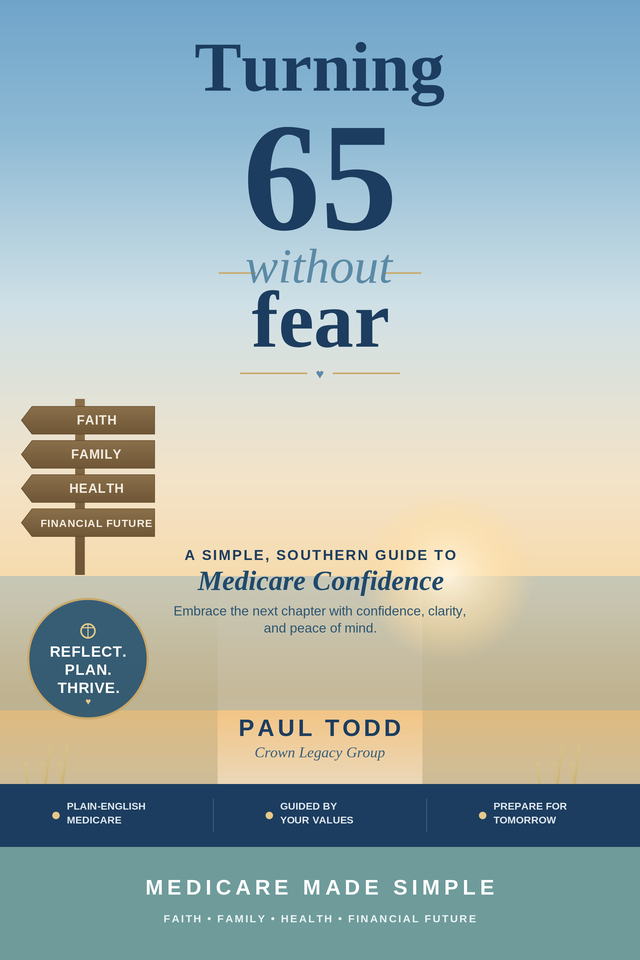
For a while now I've been writing down the way I explain this at kitchen tables — the plain version, the one without the jargon. It became a book, and it's out now: Turning 65 Without Fear: A Simple, Southern Guide to Medicare Confidence. It walks through this whole thing the way I'd walk through it sitting across from you.
You can find it here: Turning 65 Without Fear on Amazon
For now, just know this: the mail is noise. You've got more time than those envelopes want you to think, and this is far more figure-out-able than it looks today.