
The 20% Nobody Warns You About
By Paul Todd — NABIP-certified Medicare specialist and President of Crown Legacy Group. Licensed in Alabama, Florida, Georgia, Louisiana, Mississippi, South Carolina, Tennessee, Texas, and Virginia.
Published August 17, 2026 · Figures verified against CMS for plan year 2026
The short version
Medicare Part B pays 80% of the Medicare-approved amount for covered services after you meet the annual deductible, which is $283 in 2026. You are responsible for the remaining 20%.
Original Medicare has no annual out-of-pocket maximum. There is no dollar figure at which Medicare stops charging you coinsurance for the rest of the year. In a routine year, 20% is manageable. In a year involving surgery, cancer treatment, or a long hospitalization, 20% of a very large number is also a very large number.
This gap is why supplemental coverage exists. A Medigap policy covers most or all of that 20% in exchange for a monthly premium. A Medicare Advantage plan replaces the delivery of your benefits and includes a legally required annual out-of-pocket maximum. Both address the same gap by different means.

I want to walk through something that catches almost everybody, and I want to do it calmly — because the fact itself is calm. It's only alarming when nobody explains it until you're standing at a billing window.
Does Medicare cover 100% of my medical costs?
No. Medicare Part B generally covers 80% of the Medicare-approved amount for covered outpatient services, after you meet the Part B annual deductible of $283 in 2026. The remaining 20% is yours.
Most folks hear that and think: okay, 20%, that's manageable. And in most years it is. A few office visits, some bloodwork, a screening — 20% of a modest year is a modest number.
Is there a cap on what I pay under Original Medicare?
No. This is the part that changes the math, and it's the sentence I'd underline if I could underline one thing on this page.
Original Medicare — Part A and Part B by themselves — has no annual out-of-pocket maximum. There is no point in the year where Medicare says "you've paid enough, we've got the rest."
Twenty percent of a normal year is fine. Twenty percent of a cardiac event, a cancer diagnosis, a bad fall, or a long stretch of specialist care is a different conversation entirely — and it's the conversation nobody has with you in advance.
That's not a scare tactic. It's arithmetic, and I'd rather you hear it from me on a Sunday than from a statement in February.
What Original Medicare actually costs in 2026
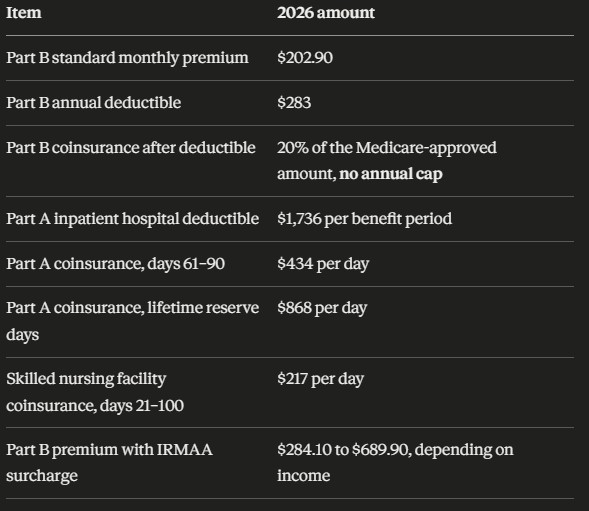
Source: CMS 2026 Parts A & B Premiums and Deductibles fact sheet. These figures change every year and are typically announced in November.
Two rows there deserve a second look. The Part A deductible is per benefit period, not per year — if you're hospitalized in March and again in October, and more than 60 days passed between them, that's two benefit periods and two deductibles. And the day-61-and-beyond coinsurance is where a long hospitalization stops being an inconvenience and starts being a financial event.
What about doctors who charge more than Medicare approves?
Here's a wrinkle most explanations skip entirely.
Providers who accept assignment agree to Medicare's approved amount as full payment. Most do. But a provider who does not accept assignment may bill you up to 15% above the Medicare-approved amount. That's called a Part B excess charge, and it sits on top of your 20%.
A handful of states prohibit excess charges outright. Among the nine states I'm licensed in, this is worth asking about directly rather than assuming — and it's one of the specific things certain Medigap plans are built to cover.
Why does this gap exist at all?
Medicare was built in 1965 as a floor, not a roof. It was never designed to be the only thing standing between a retiree and a catastrophic bill. The whole system quietly assumes you'll add something on top of it.
That's exactly why supplemental coverage exists — and why the choice between Original Medicare and Medicare Advantage is really a question about how you'd like that 20% handled, not whether it needs handling.
How do I cover the 20%?
Two roads, both of which solve the same problem by different mechanics:
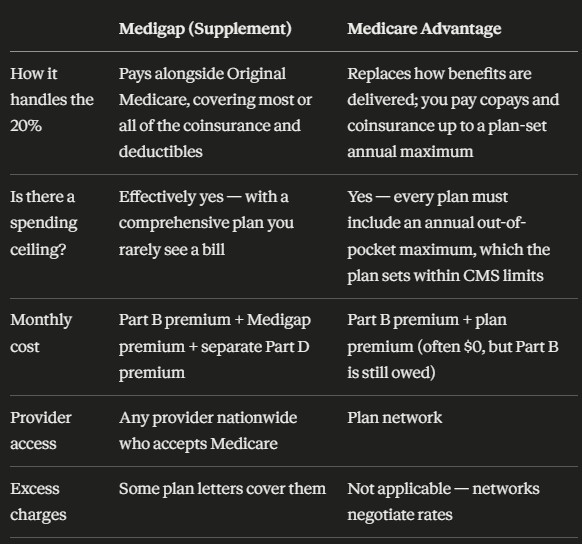
Neither is universally better. They're different instruments for the same problem, and which one fits depends on your doctors, your travel, your budget, and how much financial surprise you can tolerate.
The question this should make you ask

If you take one thing from this page, let it be a question you now know to ask:
"How is my 20% covered — and what's the most I could owe in a bad year?"
If you've got coverage in place already, you should be able to answer that. If you can't, that's not a failure on your part. It just means nobody walked you through it.
An agent who welcomes that question is worth talking to. An agent who gets uncomfortable when you ask it is telling you something important.
Frequently asked questions
Does Original Medicare have an out-of-pocket maximum?
No. Original Medicare — Part A and Part B without supplemental coverage — has no annual limit on what you can spend. Part B pays 80% of the approved amount after the $283 deductible in 2026, and you owe the remaining 20% with no ceiling. This is the single most important structural difference between Original Medicare and Medicare Advantage, which is legally required to include an annual out-of-pocket maximum.
What is the Medicare-approved amount?
It's the fee Medicare has determined is appropriate for a given service, and it's usually less than what a provider initially bills. Your 20% coinsurance is calculated on the approved amount, not the provider's original charge. So if a provider bills $1,000 and Medicare approves $600, Medicare pays $480 and your share is $120 — not $200.
What are Part B excess charges?
Providers who don't accept Medicare assignment may bill up to 15% above the Medicare-approved amount. That extra 15% is an excess charge, and it's your responsibility on top of the standard 20% coinsurance. Some states prohibit excess charges, and certain Medigap plan letters cover them. Most providers do accept assignment, but it's worth confirming with any new specialist.
How much is the Part B deductible in 2026?
$283 for the year, an increase of $26 from the 2025 deductible of $257. You pay covered Part B costs out of pocket until you reach it, after which the 80/20 split begins. It resets every January 1.
Is the Part A deductible annual?
No, and this trips people up. The Part A hospital deductible — $1,736 in 2026 — applies per benefit period, not per calendar year. A benefit period starts when you're admitted and ends after you've been out of a hospital or skilled nursing facility for 60 consecutive days. Two separate hospitalizations far enough apart mean two deductibles in the same year.
Does Medicare cover dental, vision, and hearing?
Original Medicare does not routinely cover dental care, eyeglasses, or hearing aids. It also does not cover long-term custodial care — the daily assistance many people eventually need — which surprises a great many families. Some Medicare Advantage plans include dental, vision, and hearing benefits, though allowances vary widely between plans.
Do I really need supplemental coverage?
Nobody is required to add coverage on top of Original Medicare. But going without means you personally carry that uncapped 20%, plus deductibles, for as long as you're on Medicare. For most people the practical question isn't whether to address the gap but how — through a Medigap policy's predictable premium, or through a Medicare Advantage plan's network and annual ceiling.
What is the 2026 Medicare Advantage out-of-pocket maximum?
Every Medicare Advantage plan must include an annual out-of-pocket maximum, and CMS sets an upper limit that plans cannot exceed. Individual plans often set theirs lower than the federal ceiling as a competitive feature, so the figure varies by plan and county. Check the Summary of Benefits for any specific plan — and note that in-network and out-of-network maximums are usually different numbers on PPO plans.
Ask Me the Hard Ones

Here's an open invitation: call me and ask me the toughest questions you've got. I'd genuinely rather answer them now than have you find out the answers from a billing statement.
How your 20% is handled — specifically, in your current coverage
What the most you could owe in a bad year actually looks like
Which carriers I can offer you — and which I can't, plainly
📞 Call or text me at 205-419-9732 | ✉️ [email protected]
I'm licensed in Alabama, Florida, Georgia, Louisiana, Mississippi, South Carolina, Tennessee, Texas, and Virginia. No cost for the conversation, and no obligation on the other side of it.
Call, text, or message me, or Click here to schedule a meeting with me. Use me as your practice run if you want — I mean that.
Something I've been working on
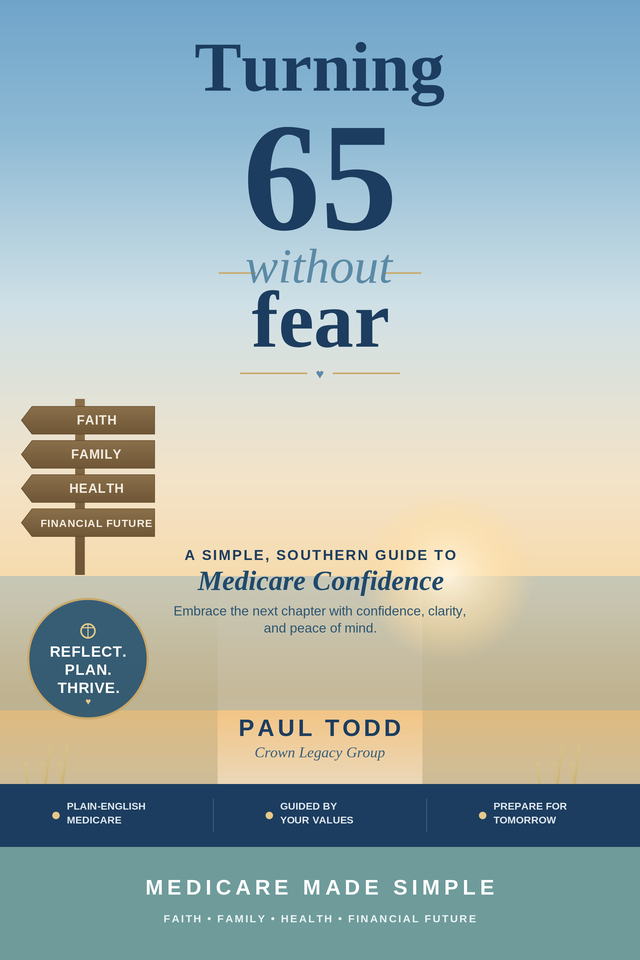
I wrote down the way I explain all of this at kitchen tables — the plain version, without the jargon. It's called Turning 65 Without Fear: A Simple, Southern Guide to Medicare Confidence, and it's out now.
You can find it here:Turning 65 Without Fear on Amazon
About the author. Paul Todd is the founder and President of Crown Legacy Group, a family-owned, carrier-independent Medicare and ACA insurance brokerage based in Birmingham, Alabama, with a second office in Nashville, Tennessee. He has specialized in Medicare for 17 years, holds the NABIP Medicare Certification, and serves on the Alabama state board of the National Association of Benefits and Insurance Professionals. He is licensed in nine states and is the author of Turning 65 Without Fear: A Simple, Southern Guide to Medicare Confidence.
This article is educational and is not a plan-specific offer. We do not offer every plan available in your area. Please contact Medicare.gov, 1-800-MEDICARE, or your local State Health Insurance Assistance Program (SHIP) for information on all of your options.