
Supplement or Advantage? A Kitchen-Table Way to Decide
By Paul Todd — NABIP-certified Medicare specialist and President of Crown Legacy Group. Licensed in Alabama, Florida, Georgia, Louisiana, Mississippi, South Carolina, Tennessee, Texas, and Virginia.
Published August 24, 2026 · Figures verified against CMS for plan year 2026
The short version
Medicare Supplement (Medigap) and Medicare Advantage are two different ways to handle what Original Medicare leaves uncovered.
Medigap works alongside Original Medicare. You pay a monthly premium, see any provider in the country who accepts Medicare, and rarely see a bill. Drug coverage is purchased separately as a standalone Part D plan.
Medicare Advantage replaces how your benefits are delivered. A private plan manages your care through a network, usually includes drug coverage and extras like dental, often charges a $0 plan premium, and caps your annual out-of-pocket spending.
Neither is better in general. The decision usually turns on five things: whether you travel, how attached you are to your current doctors, your prescriptions, your budget, and your tolerance for unpredictable costs.
The rule most people learn too late: switching from Medigap into Medicare Advantage is easy. Switching back to Medigap years later may require medical underwriting, meaning an insurer can decline you based on your health.
This is the decision. Everything else in Medicare is scaffolding around this one fork in the road.
I'm going to do something unusual here: I'm not going to tell you which one is better. Not because I'm dodging — because the question doesn't have a universal answer, and anybody who gives you one is describing their preference, not your life.
What is the difference between Medigap and Medicare Advantage?
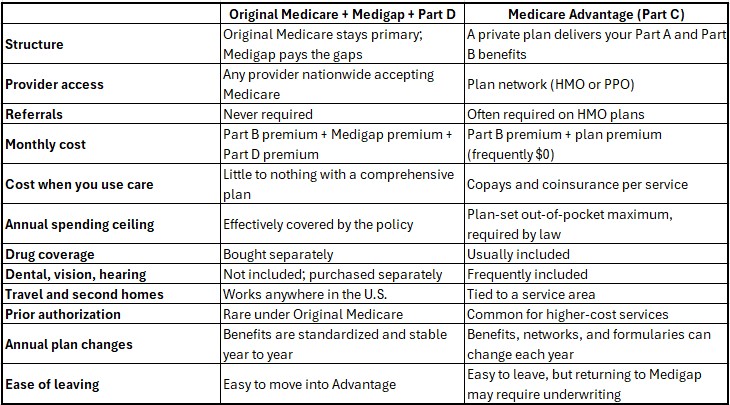
Neither road is the right one. Somebody who splits the year between two states has different needs than somebody who's had the same doctor for twenty years three miles down the road.
The five questions I actually ask
When somebody's stuck, I don't recite plan features. I ask these.
1. Do you travel, or split the year between places? Snowbirds, RV folks, and people with grandkids in three states usually feel the pull of network-free coverage.
2. How attached are you to your current doctors? If you've had the same physician for twenty years, we check networks before anything else. This is the single most common source of regret.
3. Would a surprise bill hurt, or just annoy? This is the real one, and it's about your nerves as much as your bank account. Some people sleep better with a fixed premium. That's a legitimate reason.
4. What do your prescriptions look like — and what might they look like in ten years? Not to predict the future. To think about it honestly before you're in it.
5. How much do you want to think about this every year? Advantage plans change annually and reward an annual review. Medigap benefits are standardized by letter and stay stable.
Which Medigap plan letters are available in 2026?
Medigap policies are standardized by letter. A Plan G from one carrier covers exactly what a Plan G from any other carrier covers — the difference is price and service, not benefits.
Plan F is not available to anyone who became eligible for Medicare on or after January 1, 2020. If you became eligible before that date, you may still be able to buy it. For most people turning 65 today, the practical choices are:
Plan G — covers everything Plan F does except the Part B deductible ($283 in 2026)
Plan N — lower premium, with small copays for some office and emergency visits, and it does not cover Part B excess charges
High-Deductible Plan G — much lower premium, with a deductible you meet before the plan pays
Because benefits are identical across carriers within a letter, shopping Medigap is genuinely a price-and-service comparison. That's rare in insurance and worth taking advantage of.
Can I switch from Medicare Advantage to Medigap later — and what will it cost me?
This is the asymmetry that shapes the whole decision, and it deserves more than one sentence.
Leaving Medicare Advantage is easy. You can return to Original Medicare during the Annual Enrollment Period (October 15 – December 7) or the Medicare Advantage Open Enrollment Period (January 1 – March 31).
Getting a Medigap policy to accept you afterward is the hard part. Outside your one-time Medigap open enrollment window, most states permit insurers to medically underwrite — to ask about your health history and decline you, or charge more.
Three exceptions are worth knowing, because they're the ones that actually rescue people:
The 12-month trial right. If you joined a Medicare Advantage plan when you first became eligible at 65, you have a trial right: within your first 12 months you can drop it, return to Original Medicare, and buy a Medigap policy with guaranteed issue. A similar right applies if you dropped a Medigap policy to try Advantage for the first time. This window is a genuine safety net, and it closes quietly.
State birthday rules. Several states give Medigap policyholders an annual window around their birthday to switch plans without underwriting. Among the nine states I serve, Louisiana and Virginia currently have such rules. Louisiana's provides a window following your birthday to move to a plan with equal or lesser benefits, generally within your current carrier or an affiliate. Virginia's rule is more recent. Both have specific conditions and both get amended — verify the current terms with your state department of insurance or ask me before you rely on one.
Federal guaranteed issue events. Losing employer coverage, your plan leaving your service area, or your carrier exiting the market can all trigger a right to buy Medigap without underwriting.
There's no wrong answer, only a wrong fit
I've helped people onto both roads and watched them be thrilled. I've also seen people on a plan that was fine for someone else and wrong for them.
The goal isn't the "right plan." It's the right fit for your doctors, prescriptions, travel, budget, and tolerance for surprises.
That's a kitchen-table conversation, not a checkout line.
Frequently asked questions
Which is cheaper, Medigap or Medicare Advantage?
Medicare Advantage almost always costs less per month — many plans carry a $0 premium, though you still owe the Part B premium of $202.90 in 2026. Medigap costs more monthly but far less when you use care. The honest comparison isn't monthly premium; it's total annual cost in both a healthy year and an expensive one. Advantage usually wins the healthy year. Medigap usually wins the expensive one.
What is a Medicare Advantage trial right?
If you enroll in a Medicare Advantage plan when you first become eligible for Medicare at 65, you have 12 months to change your mind. During that window, you can drop the plan, return to Original Medicare, and buy a Medigap policy with guaranteed issue rights — no medical underwriting. A comparable trial right applies if you dropped a Medigap policy to try Medicare Advantage for the first time. It's a one-time protection and it expires.
Is Medigap Plan F still available in 2026?
Only to people who became eligible for Medicare before January 1, 2020. Anyone becoming eligible on or after that date cannot purchase Plan F or Plan C because those plans cover the Part B deductible, and federal law now prohibits new Medigap policies from covering the Part B deductible. Plan G is the closest equivalent available to newly eligible beneficiaries; it covers everything Plan F does except the $283 Part B deductible.
Are Medigap plans the same across insurance companies?
Yes, within a letter. Medigap plans are standardized by federal law, so a Plan G from any carrier provides identical benefits to a Plan G from any other carrier. What differs is the premium, the rate-increase history, and the service you get when something goes wrong. This makes Medigap one of the few insurance products where comparison shopping is genuinely apples to apples.
What is the Medigap birthday rule, and does my state have one?
A birthday rule gives existing Medigap policyholders an annual window, tied to their birthday, to switch plans without medical underwriting. Roughly sixteen states have one as of 2026. Among the nine states Crown Legacy Group serves, Louisiana and Virginia currently offer birthday-rule protections, each with its own window length and restrictions on which plans you can move to. These rules are amended more often than most people realize, so confirm current terms with your state department of insurance before relying on one.
Does Medicare Advantage require prior authorization?
Frequently, yes, particularly for higher-cost services like advanced imaging, skilled nursing stays, and certain procedures. Original Medicare rarely requires it. This is a meaningful practical difference between the two roads that rarely appears in advertising, and it's worth asking about specifically for any service you anticipate needing.
Can I have both Medigap and Medicare Advantage?
No. It's illegal for someone to sell you a Medigap policy while you're enrolled in a Medicare Advantage plan, except in narrow circumstances such as when you're about to leave the Advantage plan. Medigap only pays alongside Original Medicare; it does nothing for you while an Advantage plan is delivering your benefits.
How do I know if my doctor takes a Medicare Advantage plan?
Check the plan's provider directory and then call the doctor's office directly to confirm — directories go out of date. Ask specifically whether they accept that plan for the coming plan year, since network participation is renegotiated annually. A physician who takes one plan from a carrier does not necessarily take all of that carrier's plans.
What happens to my Medicare Advantage plan if I move?
Advantage plans are tied to a service area. If you move outside it, you get a Special Enrollment Period to choose a new plan or return to Original Medicare, and that move may also trigger guaranteed issue rights for a Medigap policy. Tell your agent before you move rather than after — the timing of the notice affects which options stay open to you.
Let's have the kitchen-table conversation

This is the decision I most hate seeing people make alone. In about twenty minutes we can work through those five questions together — with your doctors, your medications, and your budget on the table.
Both roads side by side for your situation specifically
Your doctors and prescriptions checked before you commit to anything
A straight answer about what switching later would involve in your state
Call or text: 205-419-9732 · Email: [email protected] Schedule a time
Licensed in Alabama, Florida, Georgia, Louisiana, Mississippi, South Carolina, Tennessee, Texas, and Virginia. If the answer turns out to be "stay where you are," I'll tell you that too.
The book
This is the chapter people tell me they dog-ear. It's all in Turning 65 Without Fear: A Simple, Southern Guide to Medicare Confidence.
Turning 65 Without Fear on Amazon

About the author. Paul Todd is the founder and President of Crown Legacy Group, a family-owned, carrier-independent Medicare and ACA insurance brokerage based in Birmingham, Alabama, with a second office in Nashville, Tennessee. He has specialized in Medicare for 17 years, holds the NABIP Medicare Certification, and serves on the Alabama state board of the National Association of Benefits and Insurance Professionals. He is licensed in nine states and is the author of Turning 65 Without Fear: A Simple, Southern Guide to Medicare Confidence.